Your device data,EUDAMED-ready.

Your device list goes in as it is: ERP export, Excel, or CSV. It comes back mapped to 67 EUDAMED fields, classified against the EMDN tree, and put through 88 checks across 19 EUDAMED rules.

Every decision scored and recorded.

November 27, 2026 does not move.

MDCG 2024-11 sets the legacy-device timeline · Reg. 2024/1860 changed IVDR transition gates · EUDAMED schema v3.0.30

Every schema revision and guidance update, monitored and applied continuously.

Start your project →See how it works
See a sample before you upload anything →

MDR · IVDR · MDD · IVDD · Money-back rejection guarantee

EMDN Classification
DeviceEMDN CodeStatus
Surgical scissorsL010403HIGH
Knee implantP090903020104REVIEW
Diagnostic stripW0101060101CONFIRM
Suture, PDO 3-0H010101010103HIGH
4 devices3 HIGH1 REVIEW67 fields mapped
How it works

Four steps. Your device list to a submission-ready file.

01

Upload

Your data, as-is

Export your device list from SAP, Excel, or your ERP. Drop the file. No template, no reformatting required.

Accepts CSV, XLSX, ODS · up to 50,000 rows
02

Map

67 EUDAMED fields, auto-mapped

AI reads your column names and maps them to 67 EUDAMED fields. Every match gets a confidence score.

Review mismatches before proceeding
03

Classify

6,773 EMDN leaf codes

Each device is classified against the full EMDN tree. Ambiguous entries are flagged for your review. Nothing is silently guessed.

Ambiguous entries flagged for human review
04

Deliver

Submission-ready output

Clean CSV + hash-chained RDR PDF. Validated by 88 checks across 19 EUDAMED rules. Compatible with EUDAMED submission portals or direct EUDAMED import.

Full audit trail, ready for your QMS binder
See where your data stands, free →
Glass-box AI

Every decision is visible.

You approve every classification. EUDAMate shows exactly why each EMDN code was assigned, and flags what needs your review.

DeviceYour ColumnEMDN CodeConfidenceReasoning
Surgical scissorsproduct_typeL010403
HIGH
“Matched: general surgical instrument + scissors morphology”
Knee implantarticle_descP090903020104
REVIEW
“Implantable orthopedic, verify fixation method”
Diagnostic stripproduct_nameW0101060101
CONFIRM
“In vitro diagnostic, subclass ambiguous without IVD indication”
Suture, PDO 3‑0material_typeH010101010103
HIGH
“Wound closure + material field: absorbable polydioxanone”
Drapeitem_categoryT020102
HIGH
“Surgical barrier, draping. Clear category match.”
67 of the 144 EUDAMED device-data fields, mapped per device
Full audit trail in your RDR PDF
What you actually have

You won't have all 67 fields. Nobody does.

A legacy device needs 23 of them. A typical ERP export covers two or three. The rest sit in technical files, on certificates, in your GS1 account, or nowhere yet.

23
mandatory for a legacy device
17
we fill from your upload, for you to check
6
left for you, named before you start

We can't invent data you don't have. We can tell you exactly which 6.

Measured, not asserted

Scored against real submissions.

Run on registered devices, then compared field by field with what their manufacturers had submitted.

The EMDN code
Device name, as uploaded
Plasma Separators For Single Use
Nomenclature code (EMDN) · FLD-UDID-149
B030201Plasmapheresis devices and kits
WhyPlasmapheresis is the separation of plasma. Single use is a property of the device; this branch does not split on it.
Suggested, and the alternatives on screen
One line about what this device is, for example: sterile adhesive wound dressing with absorbent pad

Pick one and the field changes. Nothing is written until you approve it, on every device, including the ones already right.

38%
first suggestion
was their code
68%
on screen, counting
the alternatives
32%
needed one line
from a reviewer

500 devices from 419 companies, names only, with each company's own submissions withheld so nothing could be recognised from its history. Every code you approve feeds the next upload.

The yes/no fields
87
of every 100 filled for you
13
left blank, each with its reason
99%
of those matched
what they submitted
878
devices checked, in
21 countries

It stops where the evidence stops. Matched means matched what the manufacturer submitted, which is the only thing anyone can check.
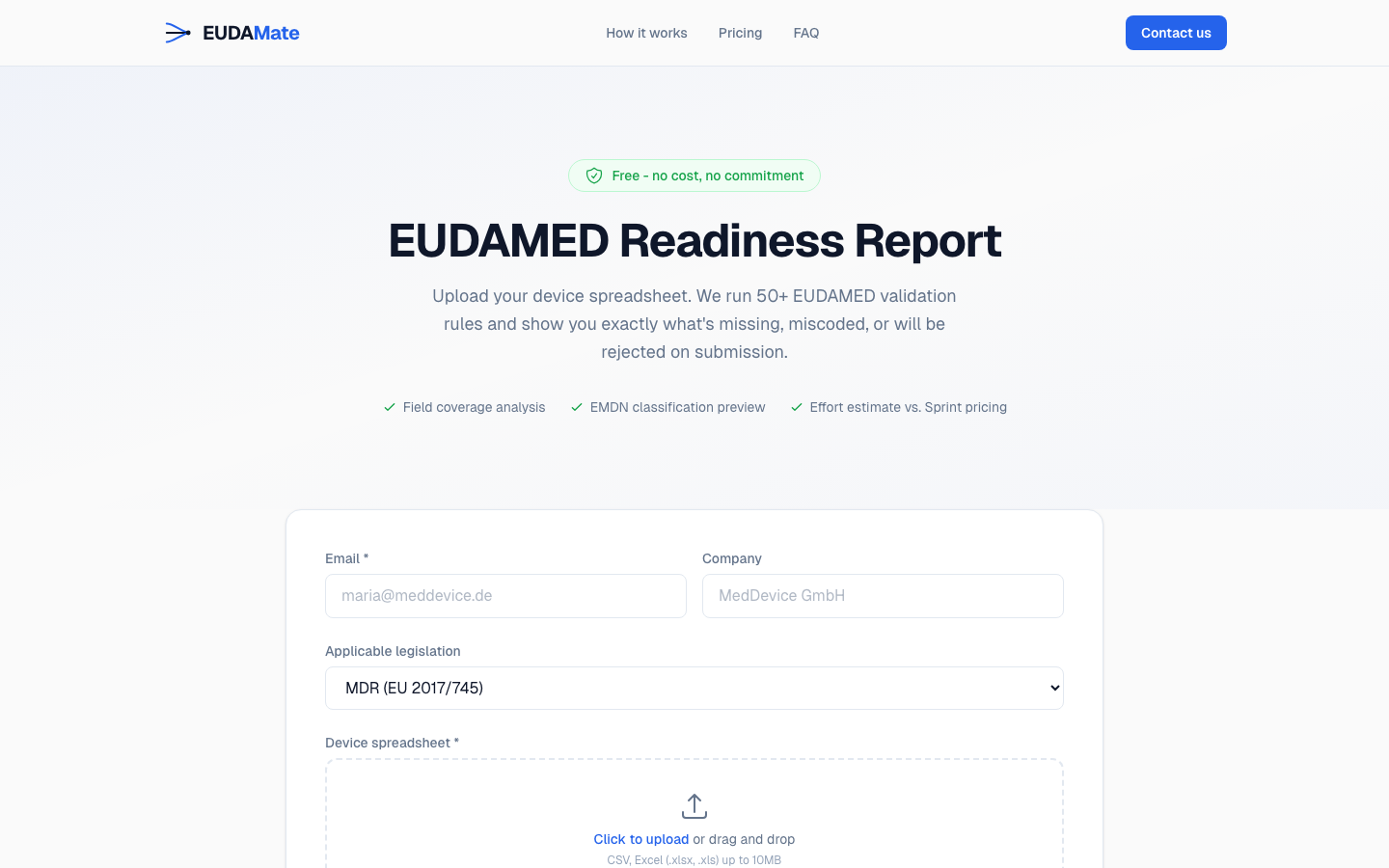
What you receive

Your Readiness Check,
in minutes.

eudamate.eu/readiness
EUDAMate EUDAMED Readiness Check
Free analysis
No template required
67-field gap report
PDF ready for your RA team
Run a free Readiness Check →

Under the hood

The details you will be asked to defend.

Every technical decision is traceable in your Registration Decision Record.

SCHEMA

Validates output against EUDAMED v3.0.30 XSD before export.

CERTIFICATES

40-NB NANDO registry integration for automatic certificate SRN resolution.

DEADLINES

IVDR Class C/D NB application deadline warnings per Regulation 2024/1860.

2024/1860

Prior NB refusal disclosure field, a new requirement under Regulation 2024/1860.

LEGACY UDI

Correct EUDAMED DI vs Basic UDI-DI distinction for legacy MDD/AIMDD/IVDD devices.

RULES

88 checks across 19 business rules, MDR to legacy, run before the clean CSV is delivered.

ISO 13485-aligned

Controlled vocabulary, append-only audit trail

MDR & IVDR ready

Plus all legacy directives: MDD, AIMDD, IVDD

EUDAMED DTX schema

CSV validated against the official EUDAMED field schema

GDPR compliant

Data processed in the EU. Project data deleted after delivery. Subscription accounts control their own retention.

PRICING

What it costs.

You see every number before you commit.

SELF-SERVE
PAY PER DEVICEPROCESSED IN MINUTES

Self-Serve

Pay per device. Your raw exports in. Clean CSV + RDR out. Preview your first device free on screen. Preparing 1 or 2 devices costs €39 in total.

Prices for manufacturers

1–2 devices€39 flat
3–24 devices€39 / device
25–99 devices€29 / device
100–499 devices€19 / device
500–1,999 devices€12 / device
2,000+ devices€7 / device

Example: two devices, no subscription: €39 once.

One-time payment per project. No VAT is charged (§19 UStG).

You never pay more than the next tier costs. 24 devices bills the same as 25, and you are credited the 25 tokens.

Processing takes minutes. Reviewing and approving the classifications is your team's work, at your pace.

INCLUDED

67 EUDAMED fields mapped per device
EMDN classification across 6,773 terminal codes
EUDAMED validation, 50+ checks
Registration Decision Record included

If your file is rejected because of a mapping or validation error we produced, you get a full refund and a corrected file. Classification decisions you reviewed and approved are recorded in your RDR, not indemnified.

Delivery guarantee

Registry CareOptional. After delivery.

Keeps your EUDAMED records current after delivery. Regulations change and certificates renew, with no per-event fees.

Micro≤10 devices
€29/mo
Starter≤50 devices
€79/mo
Standard≤200 devices
€149/mo
Scale≤1,000 devices
€349/mo

Offered after delivery. Two months free with annual billing.

Full breakdown on the EUDAMED data prep pricing page.

EUDAMate works inside your workflow.

Most manufacturers prepare a portfolio once or a few times a year. The subscription plan is built for a different workflow: multiple clients, continuous submissions, and output that carries your firm's name instead of ours. Multi-client dashboard, shared EMDN classification history, white-label RDR.

FOR RA CONSULTANTS

Bill for your judgment. We handle the labor.

Column mapping, EMDN code lookup, 67-field validation: EUDAMate handles all of it in minutes. Your clients get a clean, documented output. The time you recover goes back to the regulatory strategy, risk assessment, and notified body liaison that warrants your fee.

Every submission includes a hash-chained Registration Decision Record
EMDN classification across 6,773 terminal codes, automated and reviewable
Validation errors caught before your client touches the portal
Output goes out under your client's name, not ours

Token pricing, no monthly commitment. Full breakdown in the pricing section.

FOR REGULATORY PLATFORMS

The data layer your tool is missing.

Your tool handles the portal submission. EUDAMate handles everything before that: mapping raw device exports to 67 EUDAMED fields, running 88 validation checks, classifying EMDN codes, generating a Registration Decision Record. Integrate once as a pre-step. Your users arrive with submission-ready data rather than the raw exports they started from.

Structured CSV output your tool already understands
Full audit trail per submission: hash-chained RDR included
Validated against the EUDAMED schema before it reaches your interface
API-first: documented and testable
Integration options, white-label output, and API access by arrangement.Get in touch →

RESOURCES

Know the deadline.
Know the codes.

MDR · IVDR

May 28, 2026

MDR and IVDR devices entering the EU market on or after May 28 need a valid EUDAMED record in place.
EU 2025/2371

--days
--hrs
--min
--sec
MDD · AIMDD · IVDD

November 27, 2026

Devices placed under MDD, AIMDD, or IVDD need to appear in EUDAMED by November 27. This covers everything already on the EU market.

--days
--hrs
--min
--sec

More in the full library of EUDAMED guides, or look up a code in the EMDN code browser.

FAQ

Questions.

The output is validated against the EUDAMED v3.0.30 XSD before export, and against 88 checks across 19 EUDAMED business rules, covering MDR, IVDR and the legacy directives, before delivery. That is what we check and what we stand behind. The upload itself stays with you: EUDAMate prepares the data, it does not submit it.

No. Nothing you upload is used to train any model, and your files are processed in the EU: the spreadsheet itself is deleted once it has been parsed. One thing is kept deliberately. When you approve an EMDN code, we keep that approval, the device name it was made against, and the code, and we use it to improve EMDN recommendations. EMDN is the Commission's public nomenclature rather than anyone's property, and no customer ever sees another customer's device data. It is why your second upload is better than your first. Your prepared device data stays in your account so you can reopen a project, and we delete it on request.

No. EUDAMate is a data preparation tool with no connection to EUDAMED. We map your device data to the EUDAMED field schema, classify EMDN codes, and validate against 88 checks across 19 EUDAMED business rules. The result is a clean CSV you feed into your submission portal or tool. We are the step before submission, not submission itself.

Any tabular format: Excel (.xlsx, .xls), CSV, or TSV, including raw ERP exports. Column names can be in any language: German, French, Turkish, English. The mapping to 67 EUDAMED fields is handled for you.

Enough to start. Most ERPs hold a fraction of what EUDAMED wants, and a part number plus a description is normal. A legacy device needs 23 mandatory fields. We fill 17 of them from what you upload and list the rest field by field. We can't invent data you don't have. What we can do is tell you which fields are missing and where they usually come from, before you start instead of after a rejection.

The RDR is a PDF documenting every AI suggestion, every human override, and the reason for each decision. It's designed for your QMS binder, hash-chained and tamper-evident, aligned with ISO 13485 documentation requirements.

Every AI suggestion comes with a confidence score: Green (high confidence, auto-approvable), Yellow (moderate, review suggested), or Red (low or missing, manual entry required). You see the alternatives, you can override with a logged reason, and you approve every classification. The RDR records who approved what.

Yes. Legacy device support is a core focus. By November 27, 2026 every legacy device you are still placing on the EU market needs a EUDAMED record. Two things are out of scope. First, devices for which you place no further units on the EU market from 28 May 2026, the date the UDI/DEV module became mandatory. Second, legacy devices whose Regulation equivalent, MDR or IVDR, is already registered under the same UDI-DI, reference number or trade name, provided no change was made that assigns that Regulation device a new UDI-DI. The two exemptions come back differently. The first falls away if any post-market or vigilance action occurs. The second is narrower: the legacy device needs registering only where the action concerns the legacy device and not its registered Regulation equivalent (MDCG 2024-11, Q8 and Q14). The pipeline handles MDR, IVDR, MDD, AIMDD and IVDD, including the EUDAMED DI versus Basic UDI-DI distinction that legacy devices need.

Submission portals handle the upload to EUDAMED. They need clean, structured data to work. EUDAMate is the step before: we take your device data as it is and produce the clean CSV those portals expect. Complementary to your existing submission workflow, not a replacement.

If your file is rejected because of a mapping or validation error we produced, you get a full refund and a corrected file. We do not indemnify classification decisions you reviewed and approved. The RDR records who approved what, which is the point of it.

November 27, 2026 does not move.

Your legacy portfolio does not register itself. Preview your first device free, on screen, before you pay for anything.

Start your project →Run a free Readiness Check

€39 for one or two devices. One-time payment per project, no subscription.